

The Open Programmable Infrastructure (OPI) Project was created to make DPU and IPU infrastructure easier to consume, integrate, and scale.
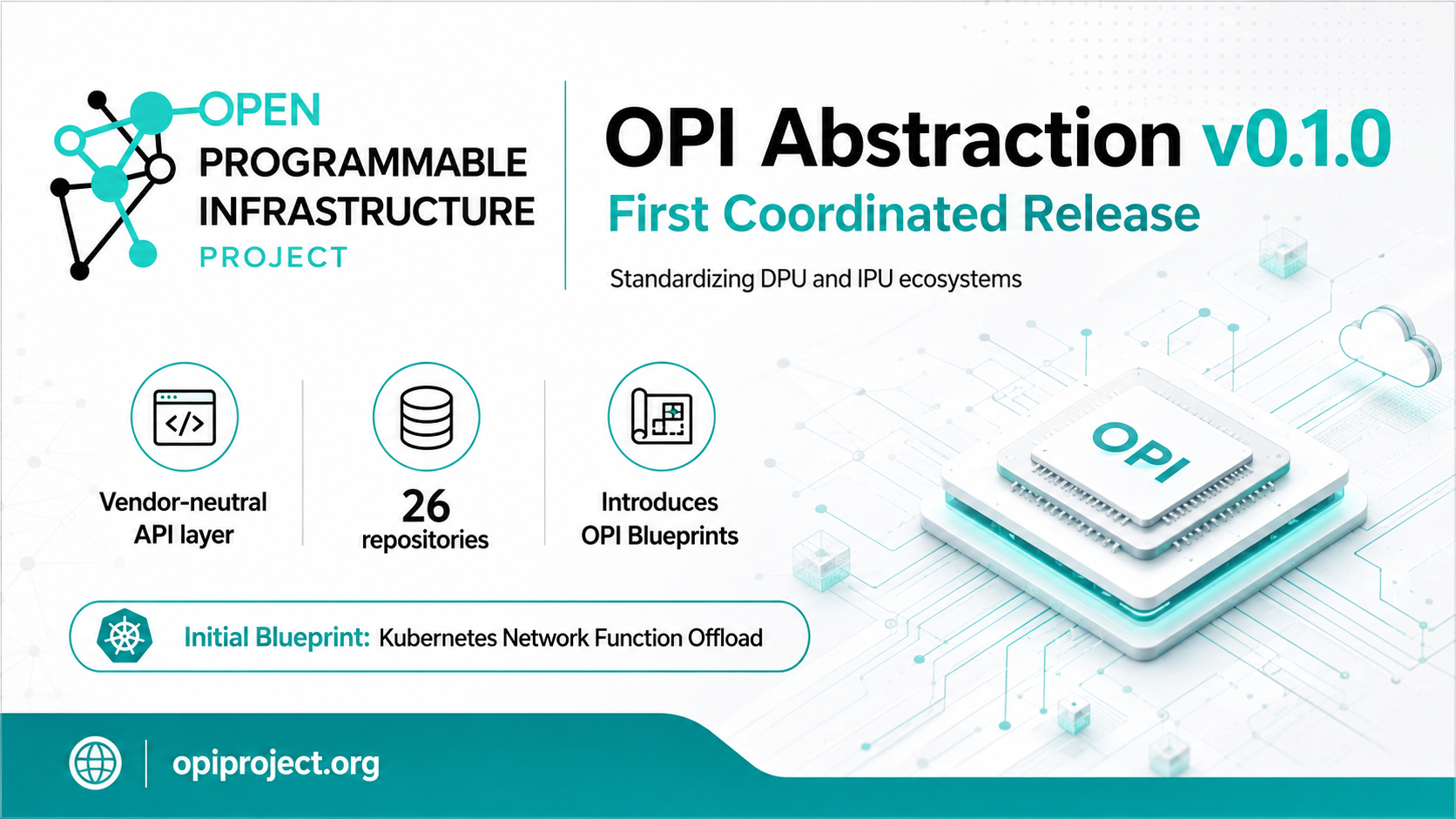
With our first coordinated abstraction release, “Abstraction” (v0.1.0), we took an important step toward that goal by establishing a vendor-neutral, hardware-agnostic API abstraction layer designed to let workloads, orchestrators, and platforms program compliant DPUs without requiring hardware-specific code. This release spans 26 participating repositories covering APIs, bridges, tooling, Kubernetes integrations, provisioning, and observability.
At the heart of this release is an important distinction: capability areas are not the same thing as OPI Blueprints. Capability areas describe the technical domains OPI enables, including Storage Offload, Secure Networking, DPU Inventory and Telemetry, and DPU Provisioning and Lifecycle. These categories show the breadth of the project and the building blocks available across the ecosystem.
An OPI Blueprint, by contrast, is about deployment. A Blueprint is a fully documented, partner-attributed, production-grade deployment pattern that can be replicated by an enterprise or systems integrator. To qualify, it must include a reference architecture, a validated bill of materials, deployment guidance with infrastructure-as-code artifacts, a business-facing use case narrative, validated test results, and clear partner attribution. In other words, a Blueprint answers the question many organizations ask first: not just can this technology work, but how do I actually deploy it in my environment?
That distinction matters. Open source infrastructure projects often provide powerful technical components, but enterprise adoption depends on having repeatable patterns that reduce risk and accelerate implementation. Blueprints help bridge that gap by translating open APIs and reference implementations into practical, validated deployment models that users and partners can trust. Based on the framework described in the release notes, OPI Blueprints make the path from innovation to production clearer and repeatable.
The Abstraction release includes one official Blueprint today: Kubernetes Network Function Offload. This Blueprint brings together partners including Intel, Marvell, Red Hat, and F5/NGINX, and is built around hardware such as the Intel IPU E2100 and Marvell OCTEON DPU, with Red Hat OpenShift as the orchestration layer and F5 NGINX as the application delivery controller. The release notes describe it as the first OPI Blueprint to meet the project’s full framework requirements, including architecture, BOM, deployment guidance, IaC artifacts, and validated test results.
Just as importantly, the Blueprint is backed by a set of validated project components. These include the opi-api repository for EVPN and networking gRPC contracts, opi-evpn-bridge as the EVPN gateway reference implementation, vendor implementations such as opi-intel-bridge and opi-marvell-bridge, Kubernetes integrations including opi-gateway-evpn-cni and opi-cni, as well as client tooling like godpu and pydpu and the opi-poc integration test suite. Together, these repositories demonstrate how OPI is assembling not just APIs, but an interoperable stack that can support real deployment scenarios.
That is what makes Blueprints so promising for the OPI ecosystem. They provide a way to demonstrate not only what OPI technology can do, but how it can be deployed in ways that are credible, repeatable, and useful for organizations evaluating programmable infrastructure. For the broader community, that creates a stronger bridge between innovation in the open source ecosystem and adoption in production environments.
As OPI evolves, Blueprints could become one of the project’s most important vehicles for adoption. They provide a way to showcase not only what OPI technologies can do, but how the ecosystem can deliver concrete solutions around them. The first official Blueprint is a meaningful start, and it points toward a future in which open programmable infrastructure is not just technically possible, but easier to deploy at scale.
Get Involved in the OPI Community
If you are building DPU or IPU solutions, evaluating programmable infrastructure, or looking for proven open deployment patterns, now is a great time to engage with the OPI community. Explore the latest release, review the official Blueprint, and see how OPI is helping turn open programmable infrastructure from an architectural concept into something organizations can actually deploy.
