

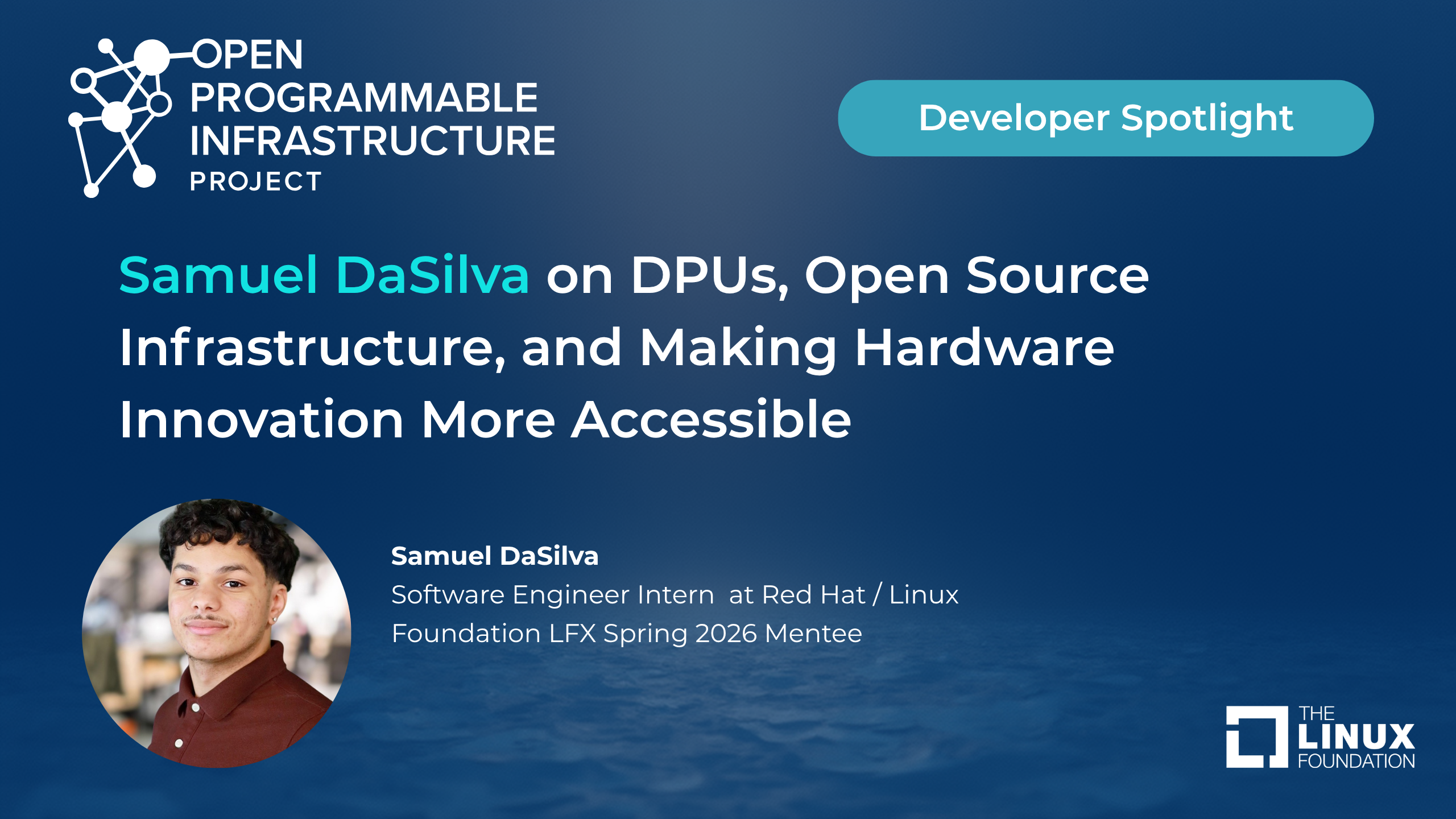
The Open Programmable Infrastructure (OPI) community brings together developers, vendors, platform engineers, and open source contributors working to advance open APIs and infrastructure for DPUs, IPUs, and programmable infrastructure.
In this developer spotlight, we meet Samuel DaSilva, a Software Engineer Intern at Red Hat and Linux Foundation LFX Spring 2026 Mentee, who is contributing to the OPI DPU Operator Enhancement effort. Samuel’s work focuses on helping move DPU development toward a more upstream-friendly, community-oriented model while supporting portability, multi-vendor enablement, and broader accessibility for developers.
Meet Samuel DaSilva
Title: Software Engineer Intern / LFX Spring 2026 Mentee
Organization: Red Hat / Linux Foundation LFX Mentorship, Open Programmable Infrastructure Project
OPI focus area: DPU Operator Enhancement, upstream Kubernetes portability, and multi-vendor DPU support
How did you first get into programming and networking?
I started programming in 2022 during the summer after my freshman year at the University of Massachusetts Lowell. Around that time, I started using Linux through Arch, Fedora, and NixOS, and got really interested in customizing my Linux environment. That eventually led me toward Universal Blue, bootable containers, and thinking more deeply about how operating systems can be built, delivered, and maintained as secure, containerized infrastructure. Before college, I mostly had a humanities background, so getting into computer science was a big shift. I quickly realized that I loved tinkering with different technologies and using them to solve novel problems. My interest in networking grew through my work at Red Hat on the Network Hardware Enablement and Cloud Infrastructure team, where I started working with OpenShift, SR-IOV, DPUs, and hardware offload. I also expanded my networking and security knowledge through competing with UMass Lowell in the Collegiate Cyber Defense Competition. As the Kubernetes and container security lead, that experience helped me connect infrastructure, networking, security, and operations in a very practical way. I also deepened my Linux and cloud-native security knowledge through my internship at Chainguard, where I worked on Wolfi packaging, hardened container images, Kubernetes security, SBOMs, and software supply chain security.
How are you involved in OPI?
I am an LFX Spring 2026 Mentee working on the OPI DPU Operator Enhancement effort. My work focuses on enhancing the DPU Operator by helping formalize opiproject/dpu-operator as the community-focused upstream and openshift/dpu-operator as the enterprise-focused downstream. I also owned the demo work around upstream Kubernetes portability and multi-vendor DPU support, which was presented at OCP EMEA 2026 in Barcelona.
What prompted you to contribute to OPI?
While working at Red Hat as a Software Engineer Intern on the Network Hardware Enablement and Cloud Infrastructure team, I got to work on innovative open source projects around DPUs and hardware enablement. A lot of that work was naturally vendor-first because of the realities of working with next-generation hardware, specialized lab environments, and platform-specific validation. Contributing to OPI felt like a great next step because it helps make the development model more community-oriented and accessible to contributors and vendors who want to push what Data Processing Units can do.
When did you start contributing?
I started contributing to OPI through the LFX Mentorship program in February 2026, though I had been following the project and related DPU Operator work before that through my work at Red Hat.
What is your favorite thing about working with OPI?
My favorite thing about working with OPI is getting to collaborate with engineers from multiple companies while doing the work in an open foundation setting. It is exciting to work in a space where hardware vendors, platform engineers, and open source contributors can come together around common APIs and shared infrastructure.
What are you most proud of?
I am most proud of helping move the DPU Operator toward a more upstream-friendly model and contributing to work that makes it easier to test, demo, and develop against DPUs through community infrastructure like the OPI lab and DPU-simulator, hosted by the ovn-kubernetes organization.
What has been the most challenging part of working with OPI?
The most challenging part has been working at the intersection of hardware, networking, and Kubernetes. DPUs involve a lot of moving pieces, including vendor-specific hardware, Linux networking, Kubernetes operators, and OpenShift integration. That complexity can make the learning curve steep, but it is also what makes the work interesting. A big part of the challenge is figuring out how to turn vendor-specific behavior into something that feels consistent and approachable for the broader community.
What advice would you give to developers interested in participating in OPI?
DPUs are not as intimidating as they first look. A lot of the time, you can think of a DPU as a small edge or IoT-like Linux server that happens to be attached through PCIe and has specialized networking and offload capabilities. You do not need to understand every piece of the hardware on day one. Start with the APIs, the operator model, and the problems OPI is trying to solve. From there, the hardware side becomes much easier to reason about.
What are you interested in outside of OPI?
Two fun facts: I love penguins, and my favorite colors are black and red. Outside of work, I enjoy watching Formula 1, listening to music, going to cafés, and experimenting with Linux systems.
Anything else you would like to share?
I am grateful to the OPI community, the Linux Foundation, and the engineers I have worked with at Red Hat for helping me grow in this space. I am excited to keep contributing to open source infrastructure and to help make DPU development more accessible to the broader community.
Get Involved with OPI
The OPI community is working to make programmable infrastructure more open, accessible, and interoperable across vendors, platforms, and use cases. Developers interested in DPUs, IPUs, hardware acceleration, Kubernetes, cloud infrastructure, and open APIs are encouraged to get involved.
Whether you are new to programmable infrastructure or already working with advanced networking and hardware offload, OPI offers a collaborative space to learn, contribute, and help shape the future of open infrastructure.
